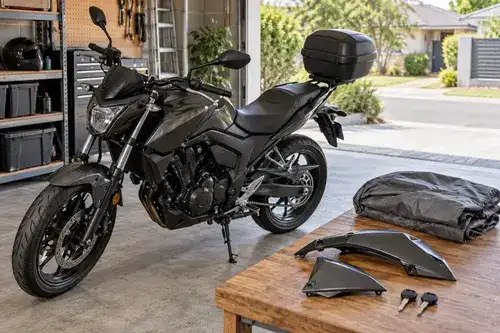
Motorcycle ignition repair after a theft attempt starts with three actions: stop, photograph the damage and report it. Do not force the key or bridge the wires behind the barrel. Once the evidence is recorded, a technician can repair or replace the damaged ignition barrel, electrical switch, steering lock or key coding.
The order matters. Evidence comes first, then the police report, then the insurer, then the repair. Moving the bike comes last and needs care, because a damaged steering lock can fail without warning. This guide sets out each step for Victorian riders and explains which repair route suits which kind of damage.
How can you tell a motorcycle's ignition or steering lock has been tampered with?
Look before you touch anything. Tampering usually leaves marks that a worn lock does not.
Check for these signs:
- Fresh scratches, gouges or bright metal around the keyhole.
- A barrel that sits proud of the surround or has been pushed in.
- A key that enters but will not turn, or turns with no resistance.
- Handlebars resting hard against a stop, or a steering lock that no longer engages.
- A cracked or bent ignition surround, or a lifted cover.
- Loose, cut or exposed wires behind the headlight or under the fairing.
- Blown fuses, or dash lights that behave oddly.
- Marks on the fuel cap, seat lock or pannier locks.
Also look at the bike itself. A bike that has moved from where you parked it, or shows scuffed levers and a bent mirror, was probably pushed or dropped. Treat that as an attempt even if nothing is missing.
Not every sticking ignition means theft. A worn key or corrosion can feel similar, but fresh marks point to force.
Hypothetical example: a rider returns to a street-parked bike and finds the forks turned hard against the stop. The key enters the barrel but turns only halfway. That pattern suggests someone levered the bars to break the steering lock, and the barrel took force. Treat it as a theft attempt until a technician shows otherwise.
What should you do first when you find the damage?
Stop and keep the bike as you found it. Every change you make can blur the record of what the thief did.
- Check that nobody is nearby. If a crime is happening or anyone is in danger, call Triple Zero (000).
- Do not try the key again. Each attempt can worsen the damage or snap the key.
- Photograph the bike and its surroundings before you move it.
- Note when you parked, when you found the damage and the exact location.
- Check for missing items such as a helmet, luggage or tools.
Write these notes while the details are fresh. Police and insurers both ask for a timeline.
What should you never do to a damaged ignition?
Several instinctive fixes make the damage worse and weaken a later claim.
Do not force the key. A bent or broken key can jam inside the barrel. Extraction then costs more than the original fault.
Do not prise, hammer or drill the barrel yourself. On many bikes the cylinder, switch and steering lock sit in one assembly. Force on one part can crack the others.
Do not jump the ignition by joining the wires behind the barrel. That wiring can feed the fuel pump, the engine computer and the immobiliser. A bridge can blow fuses, damage electronics or start a fire. It also leaves a bike that anyone can start without a key. An insurer may also question damage you caused after the event.
Do not spray heavy lubricant into the barrel. It gums the internal wafers and smears the tool marks a technician needs to read.
If the key is also missing, the lost motorbike key steps on this site cover that separate problem. This article deals with damage to the lock itself.
How do you preserve evidence for police and your insurer?
Good evidence needs nothing more than a phone and a little patience. Take photos in layers:
- A wide shot showing the bike, its registration plate and the street.
- A mid shot of the handlebars, forks and headlight area.
- Close shots of the keyhole, surround, steering lock and any exposed wiring.
- A short video walking around the bike while you say the date and time.
Do not wash or wipe the area. Fingerprints and tool marks are easily lost. If police plan to attend, ask whether they want to see the bike before anyone cleans it.
Bag and label any loose pieces, such as plastic fragments or a broken key tip.
Ask the repairer to return the damaged barrel, switch and bolts after removal. An insurer may want to inspect them, and a labelled bag is stronger evidence than a description.
Keep every receipt for towing, parts, labour and replacement locks. Record the details of any witness or nearby business with cameras. Footage can be overwritten, so give police the address and time quickly.
How do you report an attempted theft in Victoria?
Victoria Police says non-urgent crimes that have already happened do not need immediate attendance. You can report them through the Police Assistance Line and Online Reporting service or by calling 131 444. The online service runs 24 hours a day, seven days a week. Damage that the online service does not cover should be reported at a local police station.
Describe what you found, not what you assume. "The steering lock was broken and the ignition barrel was scratched" is better than "someone tried to steal it." State where and when you parked. List anything taken.
Ask for a report or reference number and write it down. Your insurer is likely to ask for it, and so is any repairer who works under a claim.
What will your insurer usually want to see?
The Victorian victims of crime service notes that insurers may ask for a police crime report and that you can obtain one from Victoria Police. Treat that report as the first document in your claim file.
Read your product disclosure statement before you call. Look for the wording on theft, attempted theft and malicious damage. Cover differs between policies. A policy that covers only damage to other people's property will generally not pay for your own bike, so confirm what yours includes.
Tell the insurer early, and before you authorise repairs where you can. Ask whether they use preferred repairers, what the excess is and which documents they need. Send the photos, the police reference, the timeline and the quotes.
Be accurate about what you saw. If you cannot tell whether damage came from the thief or a fall, say so.
What repair routes exist for a damaged ignition barrel or switch?
The barrel is the lock cylinder your key enters. The switch is the electrical unit behind it that powers the bike. Thieves can damage one or both, and the right repair depends on which part failed.
The usual routes are:
- Barrel repair or rebuild. If the damage is limited to bent or worn internal wafers, a technician may rebuild the cylinder and cut a key to suit.
- Barrel replacement. A new barrel can be coded to your existing key or supplied with new keys. Ask which one you are getting.
- Switch replacement. If the contacts are burnt or cracked, the electrical switch is replaced and the barrel may stay.
- Full ignition assembly replacement. On many bikes the barrel, switch and steering lock form one unit. It often bolts to the top triple clamp with security bolts that must be drilled or cut out.
- Wiring repair. Thieves often pull connectors or cut wires. A technician repairs the terminals, fits fuses of the correct rating and tests the circuit for continuity before power goes back on.
- Cosmetic repair. Sometimes the only damage is a dented surround or cover. Confirm that before you pay for a new assembly.
Never keep replacing blown fuses without finding out why they blew. A short circuit left in the loom is a fire risk.
Parts availability varies by make and model. Newer bikes may need manufacturer parts, and older bikes may have aftermarket kits. An ordered part adds days to the job.
How is a damaged steering lock repaired?
The steering lock is a pin that engages a notch in the steering stem so the bars cannot turn. On most bikes the ignition key operates it. Thieves break it by levering the bars hard against the lock.
Damage usually falls into three groups: a bent or snapped locking pin, a chewed notch in the stem or collar, and distortion in the steering head itself. The first is fixed by replacing the lock or the ignition assembly it sits in. The other two are structural.
Have a mechanic inspect the steering head before anyone rides the bike. Force on the bars can bend the stem, damage the steering head bearings or distort the triple clamp. Warning signs include a notchy or tight feel, a pull to one side and bars that do not centre. Check the forks, levers, mirrors and handlebar alignment as well.
What happens to keys, immobilisers and transponders after tampering?
Some bikes use a plain mechanical key. Many newer bikes use a transponder chip inside the key, which the bike reads through an antenna ring around the barrel. The immobiliser allows the engine to start only when it recognises that chip.
Tampering can damage the antenna ring or the wiring to the immobiliser unit. The result is often a flashing security light and a bike that will not start.
If the barrel is replaced, the new key set may need to be matched to the immobiliser or engine computer. Some systems let a technician add keys while an existing key is present. Others need diagnostic equipment or the manufacturer's tools. Ask early whether your provider can do the matching for your model.
If any key was lost or stolen during the incident, ask for it to be deleted from the system, not only for a new key to be added. Otherwise the old key may still start the bike.
Check whether the fuel cap, seat lock and pannier locks share a key code with the ignition. A new ignition set can change which key fits which lock.
Who can repair a damaged ignition or program new keys?
You have three main routes: a dealership, an independent motorcycle mechanic or a mobile automotive and motorcycle locksmith.
Dealerships hold genuine parts and manufacturer tools, which suits late-model bikes with complex immobilisers. Independent mechanics suit mechanical and wiring work, and they can inspect the steering head during the same visit. Locksmiths specialise in locks and keys. In Melbourne's inner south, riders can contact a locksmith St Kilda for mobile motorcycle key cutting and programming, ignition repair and broken key extraction. Riders elsewhere can look for a comparable mobile specialist near them.
Many jobs need more than one provider. A locksmith might repair the barrel and cut keys, a mechanic might check the steering head and a dealership might program the immobiliser. Ask each to confirm their scope in writing so nothing falls between them.
Reputable providers usually ask for proof of ownership, such as the registration papers and photo identification, before they cut or program keys.
Can you ride the bike before the ignition is repaired?
Usually not. Ride only if every one of these checks passes:
- The ignition switches on and off normally with the key.
- The steering moves freely from lock to lock and centres.
- The headlight, brake light, tail light and indicators work.
- No wiring is exposed or hanging near moving parts.
- Your insurer has not placed conditions on riding the damaged bike.
A bike that fails any check should travel on a trailer. A bridged ignition has no reliable off switch, and a damaged steering assembly can fail at speed.
How do you move the bike safely in the meantime?
The bars of a damaged bike may be locked, loose or bent. Rolling it by force can twist the forks.
Tell the recovery operator exactly what is wrong before they arrive. Ask for a trailer or tilt tray built for motorcycles, and for straps that do not pull on the levers or mirrors. Photograph the bike before loading so its condition is on record. The motorcycle towing guide for Melbourne covers what to ask an operator and how loading works.
If the steering lock is jammed, do not wrestle the bars. Ask a technician to attend where the bike sits, or tell the operator so they can lift it by the frame.
Until the repair is done, make the bike hard to steal. A damaged ignition may let someone start it without a key. Keep it in a locked garage or yard. Use a disc lock and a chain through the frame to a fixed anchor, and cover the bike. Do not rely on the steering lock until it has been replaced.
What should you ask before you approve a repair?
Put these questions to every provider:
- Is the barrel being repaired or replaced, and why?
- Will my existing key still work, or are new keys included? How many?
- Does the quote include immobiliser matching or key programming?
- Will you return the removed parts in a labelled bag?
- Does the quote itemise parts and labour?
- What warranty covers the parts and the work?
- Will you note what you found, for my insurer?
Keep the final invoice, the key details and any warranty paperwork. File them with the bike's motorcycle service history so a future buyer can see what changed and when. A documented repair reads better than an unexplained new ignition.
How can you reduce the risk of another attempt?
A steering lock is a minimum, not a full defence. Add layers.
Park in a garage, a locked yard or a well-lit, busy spot. Add a disc lock, or run a chain through the frame to a fixed anchor. Cover the bike so the ignition area is not on show.
Record the VIN and engine number, and keep dated photos of the bike. Store spare keys away from the bike. A thief who has tested one lock may return.
Conclusion
A theft attempt leaves two jobs: record what happened and repair what broke. Evidence, the police report and the insurer notification come first. The repair then follows the actual damage, whether that is the barrel, the switch, the steering lock, the wiring or the key coding. Until the work is done, treat the bike as easy to steal and unsafe to steer. A clear record of the incident and the repair protects the claim and the bike's future resale value.