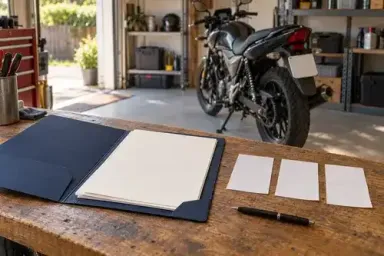
A folder of receipts can be useful without being easy to read. Some pages describe completed work, others record a purchase or an estimate, and a few may belong to another vehicle. Organising the file before a sale helps you explain what the motorcycle's history actually shows.
The aim is not to make an incomplete history appear complete. It is to give the available evidence a clear order and leave the gaps visible. A buyer can then ask sensible questions, while you can answer from the documents rather than trying to recall every workshop visit.
Before you decide to sell your motorcycle, gather the records you already hold and ask the prospective buyer which details they need to review. A service history can support the assessment, but it does not replace a check of the actual bike or guarantee a particular offer.
Sort the material into a working file
Start with one motorcycle at a time. Gather workshop invoices, inspection reports, parts receipts, owner notes and relevant photographs. Keep the documents intact while you sort them, and set aside anything that clearly concerns another vehicle.
Use a simple index to identify each document. A file name with the date and a short description is easier to find than a series of scans called “receipt1” and “receipt2”. For paper records, a numbered cover sheet can perform the same job.
GarageLog's July 2026 motorcycle maintenance log guide discusses connecting service information with dates, odometer readings and supporting records. You can organise those connections in a folder or spreadsheet without needing to adopt a particular app.
Keep originals separate from your summary. The summary helps someone navigate the file; the underlying document remains the source. If you notice a mismatch, record it for clarification rather than editing the original to make the history look consistent.
Build a chronology from the evidence you have
Place the records in date order and copy dates as they appear. Include the odometer reading where the document records it, retaining the units shown. If a receipt has no reading, leave that field unconfirmed rather than filling it from memory.
Write a short description of the event using the document's wording as your starting point. “Inspection carried out” and “part replaced” are different entries. Avoid turning a brief invoice line into a detailed account of work that the paperwork does not establish.
Oscar Gallego's October 2026 service history guide for Rydger distinguishes records made at the time from reconstructed entries and asks owners to label their own work clearly. That is a useful principle when preparing a file from material accumulated over several years.
If you are reconstructing an event from a receipt and your recollection, say so. Record the source of the confirmed details and identify what is approximate. A transparent note is more useful than a precise-looking date that nobody can support.
Read each document for what it supports
A parts receipt
A receipt can show that a particular item was purchased. It does not necessarily show that the item was fitted to this motorcycle, when it was fitted or whether the work solved a problem. Keep any installation record or relevant owner note with the receipt where one exists.
Check the description and part number before summarising it. If you cannot identify the item confidently, use the description on the document and leave the question open. Do not claim compatibility simply because the receipt was stored in the bike's folder.
A workshop invoice
A workshop invoice may describe work completed and findings recorded during a visit. Read the individual lines rather than relying on the total amount or a broad heading such as “service”. Keep any qualifications or recommendations visible in your summary.
Where the wording is unclear, ask the workshop what it can confirm through its normal records process. Do not assume every business can reconstruct an old visit immediately. If clarification is unavailable, retain the original and state the limit of the information.
An estimate or inspection report
An estimate describes proposed work and should not be listed as proof that the work occurred. An inspection report describes the assessment recorded at that time. A later repair invoice may connect to it, but make that connection only where the evidence supports it.
This distinction matters when a folder contains several documents from the same problem. Keep the sequence understandable: the concern, the assessment, the proposed work and any confirmed completion. Missing stages should remain missing rather than being inferred from the final price.
Deal with gaps and unusual entries plainly
A gap in the file can mean different things. Records may not have been passed on, owner work may not have been documented, or the bike may have spent time in storage. Explain what you know without claiming that one explanation accounts for every missing entry.
State when your own record begins. If you bought the motorcycle used, separate material received from a previous owner from work you personally arranged. That makes it easier to answer questions about the evidence you can verify directly.
Check duplicate scans and repeated invoices before presenting them as separate events. If two documents refer to the same visit, link them in the index. A thicker file should not accidentally imply more servicing than took place.
If a date, model detail or odometer entry seems inconsistent, flag it. An administrative mistake and a more significant issue can look similar in an unreviewed folder. Seek clarification where possible and leave the discrepancy visible until it is resolved.
Keep related ownership events in their own category
Not every useful record is a mechanical service record. Key replacement, transport to a workshop and an accessory purchase may help explain the ownership story, but they should not be counted as completed maintenance.
Our lost motorbike key guide covers the wider key problem. In a sale file, keep any relevant replacement record with a note of what is currently supplied, without exposing security-sensitive key information in a public listing.
Transport records can explain when a bike went to a workshop or moved between locations. The motorcycle towing guide discusses that separate service. A transport invoice is not evidence that a fault was repaired; connect it to the relevant workshop paperwork if available.
Keep modifications distinct from routine servicing as well. Record what the documents establish and whether removed original parts are included in the proposed sale. Avoid assuming that money spent on an accessory adds the same amount to the motorcycle's value.
Use the correct model information for maintenance questions
A generic checklist cannot establish whether this particular motorcycle's schedule was followed. Use the appropriate manufacturer information and qualified advice for the model, year and configuration. The service file should identify the evidence available, rather than impose intervals copied from a different bike.
Our comparison of electric and traditional motor bikes introduces differences between bike types. Those differences are another reason to keep the correct manuals and relevant records with the motorcycle being assessed.
If an instrument or major component has been replaced, retain the supporting information and explain the change. A later reading or specification may need context. Do not force it into a smooth-looking timeline by changing the earlier records.
Current maintenance questions should be dealt with separately from historical organisation. If something may be due or a fault remains unresolved, ask an appropriately qualified person to assess it. A neatly arranged file does not make a current concern disappear.
Prepare a useful review copy
Create a copy that contains the information relevant to the motorcycle and the proposed assessment. Keep unrelated personal notes and private material separate. Where documents contain personal information, consider what is necessary for the stage of the sale and use an appropriate private sharing method.
Preserve the integrity of the vehicle evidence. A buyer should be able to understand which details have been omitted for privacy and which parts describe the work. Keep your complete original records available for appropriate verification rather than altering their meaning.
Include an index and a short explanation of the file's limits. For example, you might state that it covers your ownership period and includes some earlier invoices supplied with the bike. That is clearer than calling it “full history” when the earlier years are uncertain.
Agree which records will accompany the motorcycle at handover and retain the copies you need. Check any digital export before relying on it: attachments, dates and page order should remain readable outside the app or account where they were created.
Answer questions from the record, not from the size of the folder
A buyer may ask about a particular service, a period without paperwork or an unresolved workshop recommendation. Use the index to find the source and answer within what it establishes. If you need to check a detail, say so rather than giving a confident response you later have to retract.
Do not treat the existence of invoices as proof that the bike is currently fault-free. The records describe events at particular dates. Condition can change after a service, and some issues may never have been investigated in the available history.
If an assessment leads to further questions, add the clarification without rewriting the old event. Keep a dated note of the new information and its source. This preserves the difference between what was recorded at the time and what became known later.
A fictional commuter bike folder
Imagine a rider selling a commuter motorcycle after several years of ownership. The folder contains workshop invoices, a receipt for an unfitted accessory, a towing invoice and notes about owner maintenance. The material is useful, but it does not all prove the same thing.
The rider creates a dated index, separates the accessory purchase from service work and connects the transport record to the relevant workshop visit. Owner maintenance is labelled as such. A period before the rider bought the bike remains unconfirmed because no earlier records were supplied.
The review copy now tells an understandable story without claiming a complete history or a guaranteed mechanical outcome. The example shows an organising method, rather than a prediction about the price the bike will achieve.
A readable history is an honest history
The most useful service file makes its evidence easy to find and its limits easy to understand. Clear dates, distinct document types and plainly labelled gaps help a buyer assess the history without guessing what a receipt means. That preparation supports a more informed sale discussion while leaving the motorcycle's present condition to the appropriate assessment.